13 Patents
7 granted Patents + 6 pending Patents
surface EMG · neural input
12+ yrs
surface EMG R&D
Wearable Devices Ltd.
4
product generations
consumer-proven hardware
The Challenges
EMG sensing beyond vision
Dexterous manipulation is a bottleneck in robotics. Today it’s captured with vision alone - egocentric and palm cameras - which limited in different ways:
01
Occlusions
Tools, and our own hands block camera views. Wearables utilize EMG and IMU to keep track of our hands and complete its actions.
02
Reflections and glare
Reflective surfaces degrade vision based tracking. EMG does not degrade in such cases.
03
Force is invisible
EMG correlates with force measured in Newtons. This property is unique to EMG, PPG and other wearable modalities and can be derived by trained models.
04
Motion blur
IMUs have much higher sampling rates than cameras, thereby overcoming blur when it occurs.
05
Out of FOV
When hands leave the FOV, wearable modalities are unaffected.
06
Hardware overhead
Extra cameras, mounts and calibration add cost and setup time to every session - wearables provide an alternative, cost-effective approach.
Use Kavana to scale up


Our Hardware
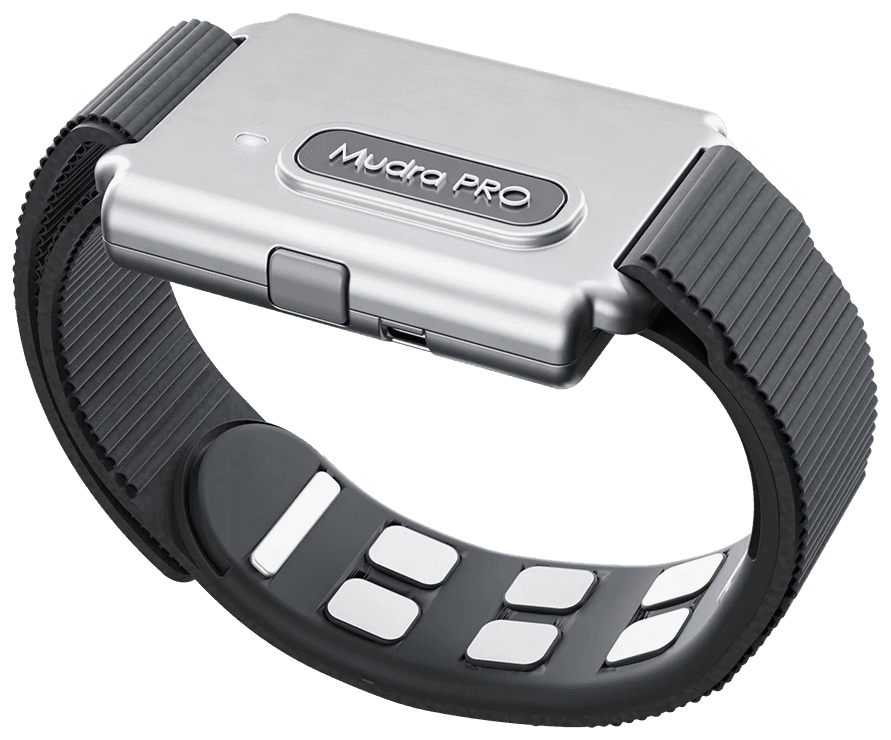
Two bands, one platform. Mudra Ultimate is the research-grade capture band for physical-AI data programs. Mudra Pro is the light, everyday band for research labs and academic groups.
Mudra Pro
Light, ergonomic and quick to fit - on in seconds and comfortable through long sessions. Cable or on-device SD capture. Built for research labs, academic groups and exploration.

Mudra Ultimate
Full-forearm coverage for spatial decomposition, Wi-Fi streaming and multi-sensor sync out of the box. Built for physical-AI companies running data collection at scale.
Specs
General
Weight
38g
43g
Fit
ergonomic fit
ergonomic fit
EMG
Channels
3 ch
8 ch
Sample rates
200 · 400 · 800 · 1600 · 2133 · 3200 · 4267 · 6400 Hz
500 · 1000 · 2000 · 4000 Hz
Noise floor
0.85 µVrms
at 400 Hz
1.16 µVrms
at 800 Hz
1.62 µVrms
at 1600 Hz
3.36 µVrms
at 2133 Hz
2.28 µVrms
at 3200 Hz
2.65 µVrms
at 4267 Hz
2.53 µVrms
at 6400 Hz
3.0 µVrms
at 500 Hz
4.1 µVrms
at 1000 Hz
6.1 µVrms
at 2000 Hz
12.5 µVrms
at 4000 Hz
DRL
Included
Included
Resolution
24 bit
24 bit
IMU
Type
6-DoF
6-DoF
Resolution
16 bit
16 bit
Sample rate
25 · 50 · 100 · 200 · 400 · 800 · 1600 Hz
25 · 50 · 100 · 200 · 400 · 800 · 1600 Hz
Gyroscope range
(configurable)
±500 dps
±500 dps
Accelerometer range
(configurable)
±4 g
±4 g
PPG
Sampling rates
25 · 50 · 100 · 200 · 400 Hz
25 · 50 · 100 · 200 · 400 Hz
Resolution
24 bit
24 bit
Connectivity
Data streaming
USB-C + BLE
USB-C + BLE / Wi-Fi
Internal SD
Optional
Optional
Software
SDK
Python · C++
Python · C++
Features
Fully Agentic · Lab Streaming Layer (LSL)
Fully Agentic · Lab Streaming Layer (LSL)
Platforms
Windows · macOS · Linux
Windows · macOS · Linux
Step 1
Scope
One call to define the task, the modalities and what “better” looks like measurably. We’ll tell you if we’re the wrong tool.
Step 2
Pilot
A bounded recording - tight protocol, small subject count, synchronised to your streams. You train on it and we both read the result.
Step 3
Scale
If the pilot moves the metric, we scale subjects, sites and session hours - we scale with you.