Our lab

What we build
The lab exists to produce datasets that combine paradigms no single sensor can cover. Each one targets a core problem in five-finger manipulation.
01
Joint-angle estimation
Ground-truth finger kinematics from optical motion capture, paired with EMG so hand pose can be learned from the wrist.
02
Computer-vision uplift
Labels that teach vision models what cameras miss: hands through occlusion, glare, low light and fast motion.
03
Applied-force estimation
Grip and contact force measured in newtons, aligned with the muscle activity that produced it.
The capture rig
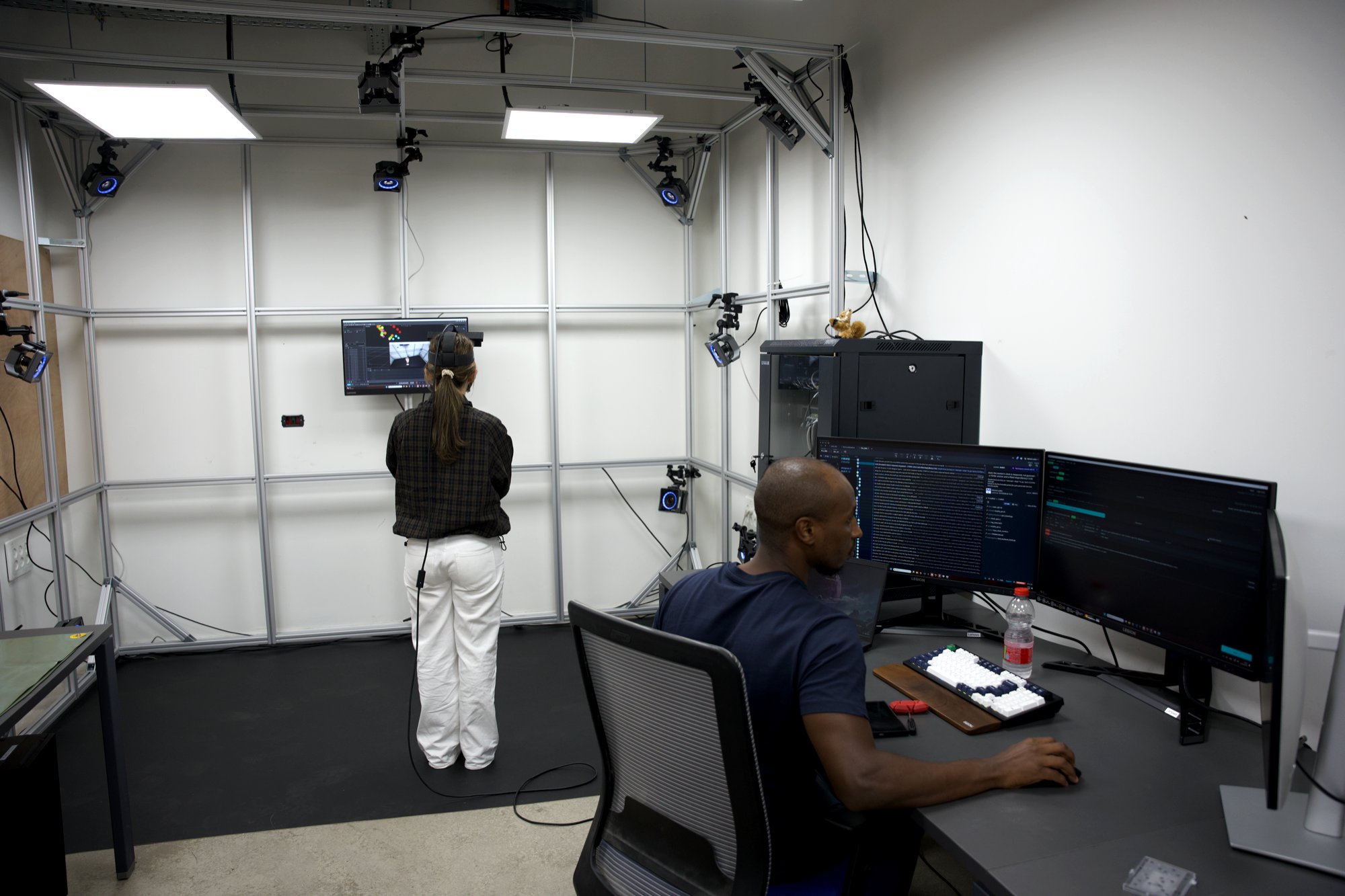
Each modality sees a different side of the hand, from the outside view of cameras to the inside view of muscle activity. For every study we combine the ones the task calls for, so each signal can supervise the others.
Motion capture
12-camera OptiTrack volume
Marker-based tracking of hand, fingers and objects, giving precise kinematic ground truth for pose.
Neuromuscular
Mudra Ultimate
8 EMG channels at 500–4000 Hz, 24-bit, with IMU and PPG, streaming over Wi-Fi. Intent and effort, read at the wrist.
Point of view
Egocentric RGB / RGB-D
Head-mounted RGB or depth cameras such as ZED record the task from the operator’s eyes, the way a robot will see it.
Force
Force sensors
Instrumented objects and surfaces measure applied force, so every grasp, press and twist comes with a number.
Tactile
Tactile glove array
A pressure-sensing array across the palm and fingers maps where, and how hard, the hand touches.

The foundation
A multimodal dataset is only as good as its alignment. The lab is built on a synchronization layer that uses proven, open methods such as Lab Streaming Layer (LSL).
Whichever streams a task uses, from the camera array to the EMG channels to the force and tactile sensors, are timestamped on a shared clock. A muscle burst, a finger flexion and a contact force line up in the same moment.

OptiTrack cameras
EMG channels
Modalities to combine
Shared clock
Research in parallel
Several research programmes run in the lab at the same time, sharing the same capture infrastructure, calibration and data formats. What one study records, every other study can build on.


Why it matters
Fine-grained, dexterous object interaction, learned from the people who do it best.
Work with the lab